Quick Answer
The best air fryer for chicken breast is the Ninja Foodi DZ201 dual-zone, because breasts of very different sizes cook at meaningfully different rates and its two independently timed baskets let you run each on its own schedule and land done together. If you'd rather not guess when it's finished, the Typhur Sync AF14's built-in wireless meat probe pulls the breast the instant it hits 165°F — the USDA's safe minimum for all poultry — without ever opening the basket. Whichever model you use, gently pounding the thicker end of a breast down to about half an inch, a trick America's Test Kitchen relies on for the grill, is what actually keeps that end from staying underdone while the thin end dries out.
Chicken breast looks like the easiest thing to air fry: no bone, no fat cap, just meat. But every whole breast has a built-in flaw — it's naturally tapered, thick and plump at one end and noticeably thinner at the other. Cook it on a single timer, the way most baskets force you to, and the thin end is done and drying out well before the thick end even reaches a safe temperature.
We looked at dual-zone timing, built-in probe thermometers, and flat cooking surfaces — not just capacity — to find four air fryers that handle that thick-to-thin taper without drying out either end in 2026.
Quick Comparison: Best Air Fryers for Chicken Breast
| Model | Basket Type | Max Temp | Best For | Price Range |
|---|---|---|---|---|
| Ninja Foodi DZ201 | Dual 4-Qt square baskets | 450°F | Best overall for mixed breast sizes | $150–200 |
| Typhur Sync AF14 | 8-Qt with wireless meat probe | 450°F | Hands-off doneness, no guessing | $160–220 |
| Cuisinart TOA-70 | Flat oven rack | 450°F | Batch-cooking several breasts at once | $200–250 |
| Instant Vortex Plus 6-Qt | Round basket | 400°F | Budget and beginners | $90–110 |
Top 4 Best Air Fryers for Chicken Breast
1. Ninja Foodi DZ201 8-Quart Dual Zone — Best Overall for Chicken Breast
Not every chicken breast in a package is the same size, and the Ninja Foodi DZ201's two independent 4-quart square baskets are the direct fix: put a smaller cutlet in one zone on a shorter timer and a larger fillet in the other on a longer one, and "Smart Finish" has both land done at the same moment instead of forcing one timer on two different-sized pieces. Each basket has its own 1,690-watt element reaching up to 450°F.
This is the only setup here that solves the size mismatch directly rather than working around it in a single basket. The trade-offs are a larger countertop footprint and a higher price than a single-basket model.
Pros: Two independently timed zones, synced finish, handles mismatched breast sizes, high heat for browning
Cons: Large footprint, pricier
Best For: Households that regularly cook breasts of noticeably different sizes together
Restocking chicken breast and other groceries for the week? try Amazon Fresh for grocery delivery alongside your air fryer order.
2. Typhur Sync AF14 — Best for Hands-Off Doneness
The tapered shape of a chicken breast makes clock-based cooking unreliable, and the Typhur Sync AF14 solves that with a world-first built-in 5-point wireless meat probe, NIST-verified to ±0.5°F, that tracks the internal temperature in real time and alerts you the instant the breast hits 165°F — without ever opening the basket and losing heat. The 8-quart capacity and PFAS-free ceramic-and-silicone grill plate handle a full-size fillet with room to spare.
It's a 9-in-1 unit (air fry, roast, bake, grill, dehydrate, and more) with a 105–450°F range, though it's app-only for the probe readout rather than voice-assistant controlled.
Pros: Wireless probe removes the guesswork entirely, no basket-opening needed to check doneness, 9-in-1 versatility
Cons: App-only monitoring, pricier than a basic basket model
Best For: Anyone who consistently over- or under-cooks chicken breast by the clock
Check Typhur Sync Price on Amazon →
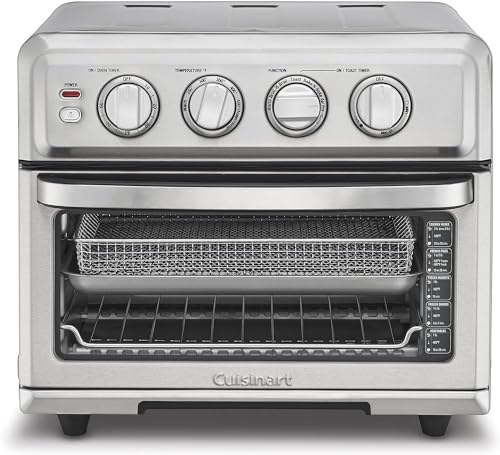
3. Cuisinart TOA-70 Air Fryer Toaster Oven — Best for Batch Cooking
Feeding more than one or two people means cooking several breasts at once, and a flat oven rack handles that better than a round or square basket. The Cuisinart TOA-70's wide rectangular tray lays multiple same-size breasts flat, side by side, so every piece gets equal airflow and finishes together — as long as the batch is one size per run.
It also functions as a full toaster oven, convection oven, and broiler. The trade-offs are a larger footprint and a higher price than a basket-style unit.
Pros: Widest flat cooking surface, cooks the most breasts at once evenly, doubles as a full oven
Cons: Big footprint, pricier, best with one size per batch
Best For: Families or meal-preppers cooking four or more breasts at a time
4. Instant Vortex Plus 6-Quart — Best Budget Pick
For a straightforward, single-basket unit at a lower price, the Instant Vortex Plus's EvenCrisp technology and simple preset dial make it easy to hit standard chicken breast times without extra features to learn. The ClearCook window lets you check browning visually partway through without opening the basket.
Its 400°F ceiling is a touch lower than the other three picks, which matters less for chicken breast than it would for a food that benefits from a harder sear.
Pros: Simple preset dial, EvenCrisp technology, ClearCook viewing window, affordable
Cons: Single round basket, 400°F ceiling
Best For: Anyone cooking one or two standard-size breasts and wanting a straightforward unit
Check Instant Vortex Plus Pricing →
What Makes an Air Fryer Good for Chicken Breast?
The Tapered-Thickness Problem
This is the variable that trips up more chicken breast cooks than any other. A whole breast is naturally thicker at one end than the other, and cooked on one timer, the thin end finishes first and keeps drying out while the thick end catches up. America's Test Kitchen's standard fix is to gently pound the thicker end down to about half an inch so the whole piece cooks at roughly the same rate.
Wireless Probe vs. Clock-and-Thermometer
A built-in wireless probe removes the guesswork entirely by tracking internal temperature in real time and alerting you at the target, rather than requiring you to open the basket and check with a handheld thermometer — which briefly drops the air fryer's temperature and adds cook time each time you do it.
Basket or Rack Space for Multiple Breasts
Overlapping breasts blocks the circulating air an air fryer relies on for even cooking. A flat rack or a basket with enough surface area to lay several same-size breasts side by side, without stacking, cooks a batch far more evenly than crowding a smaller basket.
How to Air Fry Chicken Breast Without Drying It Out
Pat breasts dry and season, then place them in a single uncrowded layer. Flip halfway through the cook time for even browning on both sides.
Cook time scales with size, not a fixed number: according to Springer Mountain Farms' time-and-temperature guide, a 4–5oz breast takes about 10–12 minutes, a 6–8oz breast takes 13–15 minutes, and a 9–12oz breast can take 16–20 minutes, all at around 375°F. Confirm doneness with an instant-read thermometer at the thickest part rather than the clock alone — pull chicken breast at 165°F, the USDA Food Safety and Inspection Service's safe minimum internal temperature for all poultry.
Frequently Asked Questions
What is the best air fryer for chicken breast?
The best air fryer for chicken breast is the Ninja Foodi DZ201 dual-zone, because breasts of different sizes cook at different rates and its two independently timed baskets let you run each on its own schedule and finish together. If you'd rather not guess when it's done, the Typhur Sync AF14's built-in wireless meat probe pulls the breast the instant it hits 165°F without opening the basket. Whichever model you use, pounding the thicker end of a breast down to about half an inch keeps that end from staying underdone while the thin end dries out.
What temperature should I air fry chicken breast at?
Air fry chicken breast at 360 to 400°F, with 375°F as the most common target. Cook time depends on size: a 4-5oz breast takes about 10-12 minutes, a 6-8oz breast takes 13-15 minutes, and a 9-12oz breast can take 16-20 minutes, according to Springer Mountain Farms' time-and-temperature guide. Flip halfway through for even browning.
How long do I air fry chicken breast for?
Cook time scales with weight, not a single fixed number: about 10-12 minutes for a 4-5oz breast, 13-15 minutes for a 6-8oz breast, and 16-20 minutes for a 9-12oz breast at 375°F, flipping halfway. Always confirm with an instant-read thermometer at the thickest part rather than relying on the clock alone, since breast size and shape vary widely even within one package.
Why does one end of my chicken breast come out dry while the other is undercooked?
A whole chicken breast is naturally tapered, meaning one end is noticeably thicker than the other. Cooked on a single timer, the thin end finishes first and keeps drying out while the thick end catches up. America's Test Kitchen's fix is to gently pound the thicker end down to about half an inch so the whole piece cooks at roughly the same rate.
Do I need to flip chicken breast in the air fryer?
Yes. Flipping chicken breast halfway through the cook time promotes even browning and more even cooking on both sides, and most time charts, including Springer Mountain Farms', assume a midpoint flip.
Is chicken breast safe to eat at 165°F?
Yes. The USDA's Food Safety and Inspection Service sets 165°F as the safe minimum internal temperature for all poultry, measured at the thickest part of the meat. Unlike pork, there's no separate rest-and-carryover allowance for a lower pull temperature; 165°F is the number to hit.
Final Recommendation
For most households, the Ninja Foodi DZ201 is the best air fryer for chicken breast: its two independently timed zones directly solve the problem of cooking different-sized breasts together. If you struggle with the tapered thick-to-thin shape specifically, the Typhur Sync AF14's wireless probe takes the guesswork out entirely, and the Instant Vortex Plus is the easiest budget option for a single standard-size breast. Whichever you choose, a thermometer and the 165°F rule matter more than any single feature — that's what actually keeps a breast from drying out or falling short of safe.